
A money mindset is the collection of largely unconscious beliefs and emotional reactions about money that shape how someone actually behaves with it, regardless of how much they know about budgeting or saving. Almost everyone has one, formed long before they were old enough to choose it, usually out of family habits, early experiences, and whatever money seemed to mean inside a particular household. Most explanations jump straight to whether yours is scarcity or abundance, but that distinction means very little until you understand why unconscious belief outweighs conscious financial knowledge in the first place. What follows lays out what a money mindset actually is, where it comes from, and why two people with the same income can behave in completely different ways around the same dollar.

The Pattern That Has Nothing to Do With the Number
What is a money mindset? It is the set of largely unconscious beliefs and emotional reactions about money that shapes how a person actually behaves with it, regardless of how much they know about budgeting or saving. I learned how much those unconscious patterns matter not from a finance background, but from over twenty years sitting with people near the end of their lives. The most revealing thing I ever learned about a person was rarely what they had accumulated. It was what they could never quite bring themselves to spend, give away, or trust themselves to earn enough of, and the pattern had almost nothing to do with the number in the account.
I watched people with comfortable savings still flinch at a restaurant bill, and I watched people with almost nothing insist on paying for someone else’s coffee without a second thought. Neither of them could have told you why, not specifically, because the belief driving the behavior had been running underneath their attention for decades. That is the part most explanations of money mindset skip past too quickly. Everyone has one, including the people who have never once used the phrase to describe themselves, and the only real question is whether you know what yours is telling you or whether it is simply making decisions before you get a vote.

What a Money Mindset Actually Means
A money mindset is not a personality trait, and it is not the same thing as financial literacy. It is a set of beliefs, attitudes, and patterns about money that formed through early life experience, the way money was talked about or avoided at home, the broader cultural messages absorbed without ever choosing them, and whatever personal history happened to attach itself to a dollar along the way. Most people’s money mindset was already largely in place before they were old enough to make a single real financial decision on their own. By the time someone gets their first paycheck, the beliefs are usually just confirming a pattern that was set years earlier.
Some of that pattern is conscious. Most of it is not. A person can read every personal finance book available and still flinch the same way at the same kind of expense, because the flinch was never coming from a lack of information. I sat with a man once, well into his seventies, who had more than enough saved to be comfortable for the rest of his life and still counted out exact change at every register out of a habit formed during a childhood where money ran out before the month did. He knew, intellectually, that he no longer needed to do that, and knowing did not change the reflex. That gap between knowing and doing shows up everywhere, not just with money, and what actually moves someone to change a long-held habit is its own question worth sitting with separately.
Why Two People With the Same Income Behave Completely Differently
Most of what gets written about money mindset moves quickly to a single distinction: scarcity thinking versus abundance thinking. That framing is not wrong, but it skips the more useful question underneath it, which is why unconscious belief outweighs conscious knowledge in the first place. Two people can have identical income, identical financial education, and identical access to the same information, and still behave in completely different ways around the same dollar, because their underlying beliefs about what money actually means are not the same at all.
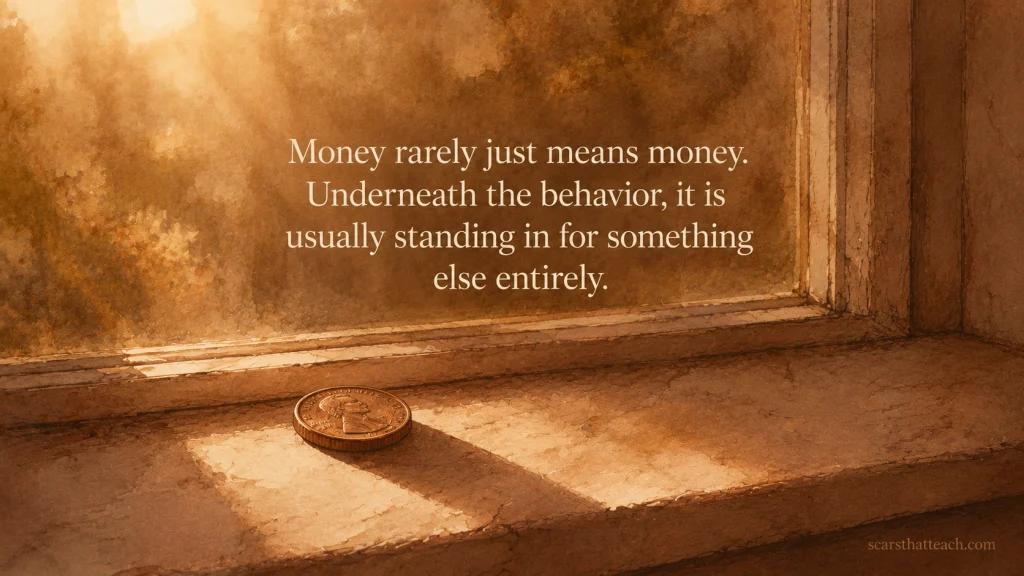
Money rarely just means money. Underneath the behavior, it is usually standing in for something else entirely:
- Safety, where spending feels dangerous even when the numbers say otherwise.
- Worth, where earning or having money becomes proof of being valuable.
- Danger, where money itself feels like something that causes conflict or loss.
- Freedom, where money is mainly valued for the choices it can buy.
- Identity, where spending or saving patterns become tied to who a person believes they are.
Which of those a person is actually responding to rarely shows up as a clear thought. It shows up as a reflex: the flinch at a bill, the discomfort accepting a gift, the inability to charge what work is actually worth. Some researchers call these patterns money scripts, unconscious rules absorbed early and replayed automatically for decades unless something interrupts them. None of that requires a diagnosis or a formal label to be useful. It just requires noticing which version of “money means something else” tends to show up in your own reflexes, because that noticing is usually the first real movement that happens.
Why This Matters More Than It Sounds Like It Should
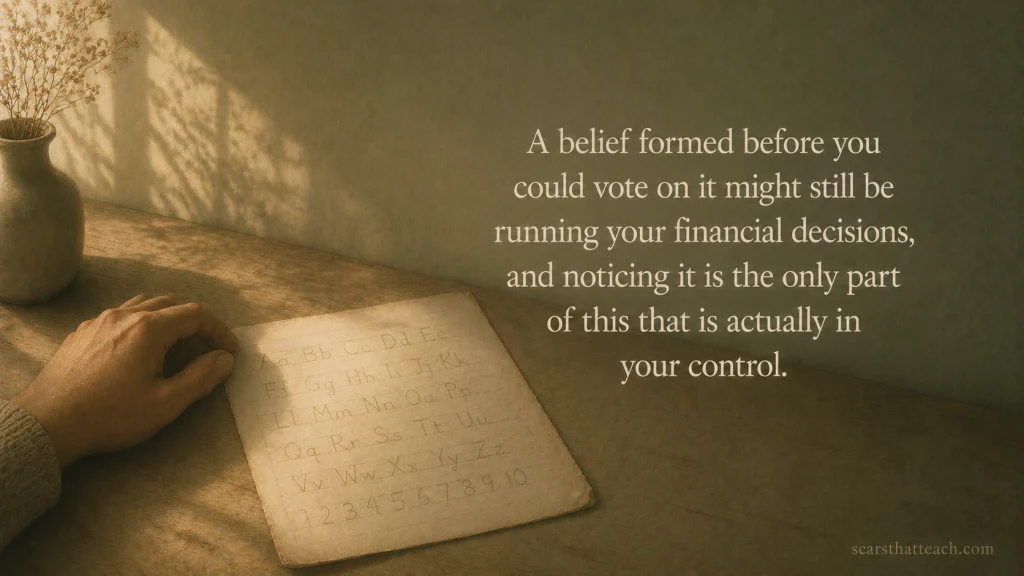
None of this is about diagnosing yourself or sorting people into scarcity or abundance and calling it finished. It is about noticing that a belief formed before you could vote on it might still be running your financial decisions, and that noticing it is the only part of this that is actually in your control. The number in the account was never really the point, not for the people I sat with at the end of their lives, and it is rarely the point for anyone still in the middle of theirs.
If you want to look more closely at how a pattern this old gets set in the first place, how childhood shapes your relationship with money goes further into where these beliefs actually come from. And if this is the first time you are hearing the term, the broader look at how a money mindset actually forms and changes covers the rest of what is worth knowing.
FAQs
💭 What is a money mindset?
It is the set of largely unconscious beliefs and emotional reactions about money that shape how you actually behave with it, separate from how much financial knowledge you have. Almost everyone has one, whether they have ever used the term or not.
🌱 What does money mindset mean exactly?
It refers to the beliefs and emotional patterns about money that were mostly formed early in life, through family habits, cultural messages, and personal experience. Those patterns shape financial behavior even when someone is not consciously aware of them.
👶 Can your money mindset change as an adult?
Yes, but it tends to change through noticing the pattern in actual moments, not through reading more about finance. Awareness of the underlying belief usually has to come before the behavior shifts.
⚖️ Is having a scarcity mindset about money a bad thing?
It is not a flaw, and it usually formed for a real reason, often out of genuine instability earlier in life. The more useful question is not whether it is bad, but whether it still matches your actual circumstances now.
🧩 How do I figure out what my money mindset actually is?
Pay attention to the moments where your reaction to money feels bigger than the situation calls for, a flinch at a small expense or discomfort accepting a gift. That reaction is usually pointing at the belief underneath it.
💸 Does knowing more about finance change your money mindset?
Not on its own. Financial knowledge can tell you what to do with money, but it rarely touches the unconscious belief about what money means, which is usually the thing actually driving the behavior.