
Most people use the phrase “let go of control” without ever defining what it actually requires of them. I spent two decades watching dying patients and the families around them wrestle with exactly this, and the pattern was always the same: the people who actually got there were not the ones who stopped caring, but the ones who learned to separate caring from controlling. What letting go of control actually means is a specific, three-part shift, not a single decision or a mood you talk yourself into. This piece walks through what that shift looks like, why the generic version of this advice leaves people stuck, and what to do instead when the discomfort of not controlling something will not go away on its own.
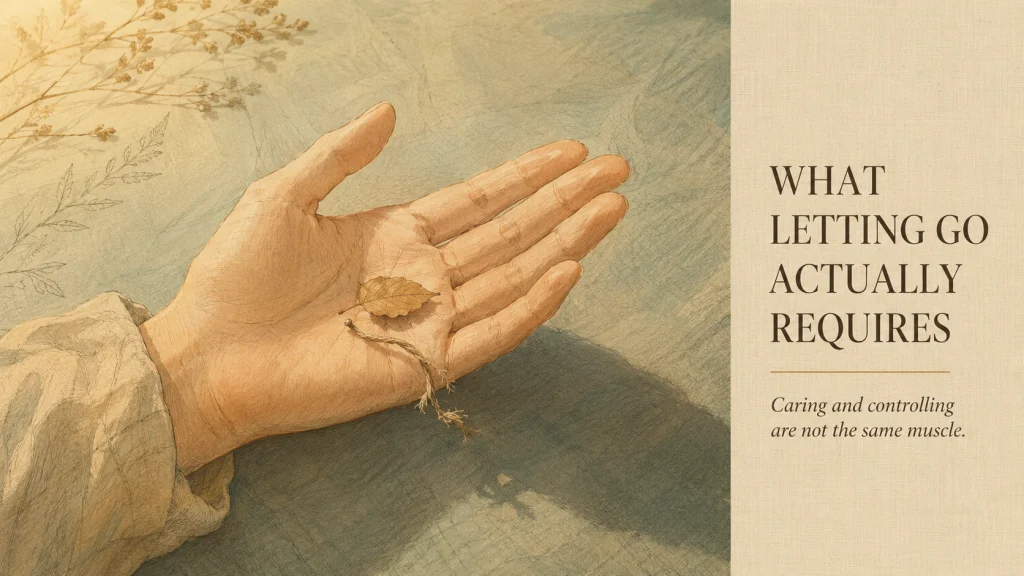
What Letting Go of Control Actually Means
I sat with a man once whose adult son had been making the same destructive choices for years. The father had tried everything: ultimatums, silence, money, more silence. What changed, near the end of his own life, was not that he stopped caring about his son. It was that he finally separated two things he had spent decades treating as one. Caring about an outcome and needing to control that outcome turned out to be entirely different muscles, and the second one had been making the first one almost impossible to sustain. That is what letting go of control actually means: not indifference, not surrender, but a redirection of where a person puts their energy once they can see clearly what was never theirs to manage in the first place.
This is the part most advice on the subject skips. People are told to “let go” the way they might be told to relax, as if it were a switch. It is not. It is a practice with identifiable parts, and most people who struggle with control are not failing at willpower. They are missing the map.
What Psychological Research Says About Letting Go
I am not a psychologist, and I never pretended to be one in twenty years of chaplaincy work. But somewhere along the way I read research that gave a name to what I had already watched happen hundreds of times, and it stopped me for a moment. Acceptance and Commitment Therapy calls it psychological flexibility, the capacity to stay present with a situation and adapt to it without needing to control the emotions or outcomes inside it. The researchers Kashdan and Rottenberg, writing in 2010, treated that capacity as one of the strongest predictors of whether a person comes through a hard season of life intact. Reading that felt less like learning something new and more like finally having a word for something I had been describing in longer sentences for years.
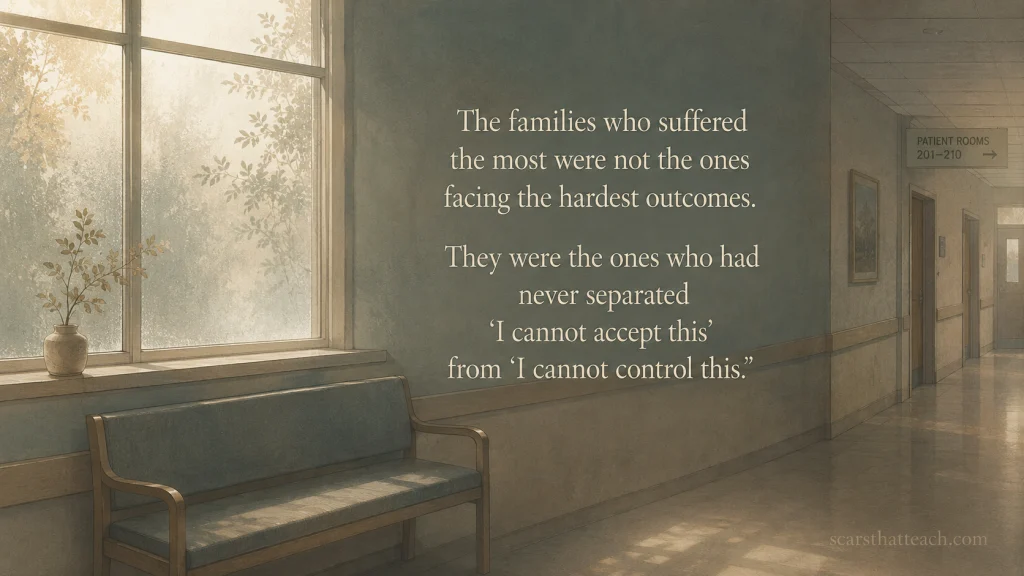
What I noticed, more times than I can count, is that the families who suffered the most were not the ones facing the hardest outcomes. They were the ones who had never separated “I cannot accept this” from “I cannot control this.” Those are different sentences, and confusing them is exhausting in a way that has nothing to do with how strong or weak a person is. The rooms taught me that distinction long before I had research to back it up.
None of this happens because control is a character flaw. People reach for it because it works, at least for a while, and because doing something almost always feels safer than sitting still with an outcome you cannot touch. The father I mentioned was not controlling because he loved his son too little. He was controlling because the alternative, watching someone you love make choices you cannot stop, is one of the hardest things a person can be asked to tolerate. Understanding that does not make the letting go easier, but it does make it less shameful, and shame is usually what keeps people gripping tighter long after gripping has stopped helping anyone.
The Three-Part Shift Most Advice Skips
Knowing why you reach for control does not, by itself, loosen your grip on it. What loosens it, based on what I watched work over two decades, is breaking the process into parts you can actually act on. The practical content of letting go comes down to three distinct moves, and missing any one of them is usually why people feel stuck even after they have decided, in theory, to let go.
I have watched all three of these happen, in the right order, in people who genuinely came out the other side of something they could not control. I have also watched people skip straight to the third without doing the first two, and wonder why nothing felt lighter.
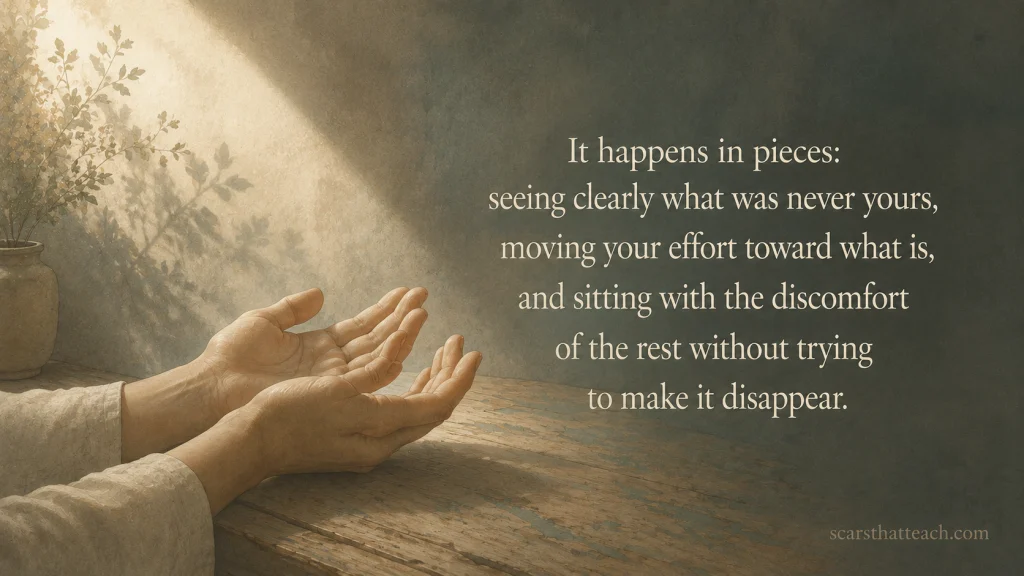
- Seeing clearly, often for the first time, what is and is not actually yours to control. Most people overestimate this badly, especially with the people they love most.
- Moving the energy you were spending on the uncontrollable toward the parts of the situation that are genuinely yours to shape.
- Staying with the discomfort of not knowing how it ends, instead of acting just to make that discomfort go away.
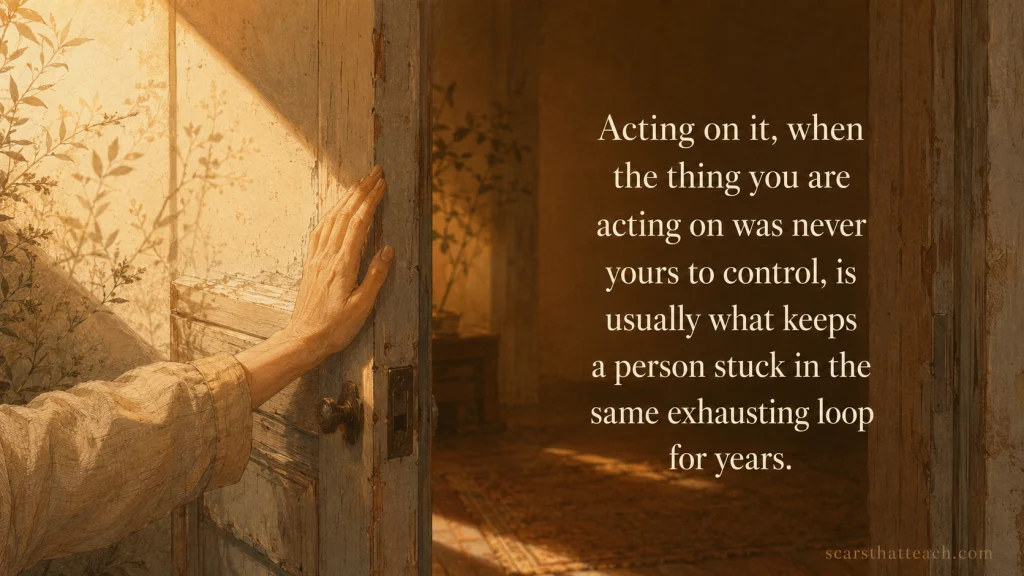
That third part is the one people skip fastest, because it is the least satisfying. It does not feel like progress to sit with discomfort instead of acting on it. But acting on it, when the thing you are acting on was never yours to control, is usually what keeps a person stuck in the same exhausting loop for years. I watched it happen with siblings who could not stop trying to fix a parent’s marriage, with parents who could not stop managing an adult child’s choices, with spouses who could not stop trying to control how someone else grieved.
What People Get Wrong, and Why It Happens
The most common mistake is treating letting go as something you decide once, the way you might decide to quit something. It does not work that way, and people set themselves up to feel like failures the first time the old impulse to control comes back, which it always does. Letting go is not a finish line. It is a practice you return to, sometimes daily, sometimes for the same situation for years.
The second mistake is mistaking detachment for letting go. I sat with people who had simply stopped engaging, who told themselves this was peace when it was actually exhaustion wearing peace’s clothes. There is a real difference between someone who has redirected their energy toward what they can influence and someone who has just stopped trying because trying hurt too much. The first is a shift. The second is a retreat, and it tends to leave a quieter kind of regret behind it.
Most people do not let go of control because they finally stopped caring. They let go because they finally saw, clearly, which parts of the situation were never theirs to hold.
That distinction is not something a person can talk themselves into in a single afternoon. It tends to arrive the same way most clarity arrives in this work: slowly, after enough repetition, usually after the old way has failed one too many times to keep pretending it might still work.
Final Thoughts: A Practice, Not a Decision
If you are in the middle of trying to let go of something right now, here is what I would say to you in the room, the way I said it to people for twenty years. See clearly, first, what is actually yours in this situation, before you try to make peace with the rest of it. Your specific history matters more than any framework I can hand you here. What I watched across two decades does not apply the same way to every relationship, every loss, every kind of choice someone else is making that you cannot unmake for them. If the thing you are holding depends on details only you know, trust those details over a tidy three-part process.
What I can tell you, after two decades of watching people arrive at this from every possible direction, is that the ones who got there were never the ones who cared the least. They were simply the ones who finally knew what they were carrying, and what they were not.
For a closer look at why the need to control takes hold in the first place, my piece on what makes letting go of control so difficult goes deeper into the roots of it. And if you are looking at this through a wider lens, the broader collection on life lessons worth carrying into hard moments covers the kind of ground this piece only touches on.
FAQs
🤔 What does letting go of control actually mean?
It means separating caring about an outcome from needing to control it. You keep caring. You stop demanding that the outcome bend to your effort.
🔄 Is letting go of control the same as giving up?
No. Giving up is disengaging from something you still want. Letting go means staying engaged with what you can influence and releasing what you cannot.
⏳ How long does it take to let go of control over something?
There is no fixed timeline. For most people I sat with, it came in waves over months or years, not in a single moment of realization.
💔 Why does letting go of control feel so uncomfortable?
Because the uncertainty does not go away just because you stop fighting it. The discomfort is the price of accuracy about what was never yours to hold.
🧭 How do I know what is actually within my control?
Ask whether your effort changes the outcome or just your own anxiety about it. If it is the second, the situation likely belongs in the category you cannot control.