The first thing I learned, and the one that took me the longest to actually absorb, was that dying people are not extraordinary. They are ordinary people who have run out of the ordinary reasons to pretend that the ordinary things are not what matters. Twenty years of sitting with people at the end of their lives did not hand me a list of deathbed wisdom. It handed me a small set of patterns that kept repeating, across hundreds of rooms, regardless of who was in them. This is not advice. It is closer to testimony, the residue of what I actually witnessed, offered without the certainty of a checklist.
Dying People Are Not Extraordinary
I expected, going into this work, that proximity to death would reveal something rare in people, some hidden depth that ordinary life kept buried. It took me years to realize the opposite was closer to true. What dying revealed in most people was not a hidden depth. It was the same depth that had been there all along, finally visible because the person had stopped maintaining the performance that ordinary life requires. The husband who had spent forty years deflecting compliments with a joke would, in his last weeks, simply say thank you and mean it. The depth was not new. The deflecting had just finally stopped.
This reframed how I understood my own work almost immediately. I was not extracting wisdom from people who had earned some special access to it through suffering. I was watching people set down a performance most of us carry for most of our lives, the performance of being fine, of having time, of not needing to say the important thing out loud yet. What looked like wisdom was often just honesty, arriving later than it should have, because most of life gives people too many ways to avoid it.
Relationships Get Named First, Almost Without Exception
If you sit with enough dying people, a pattern becomes impossible to miss. When people talk near the end about what their life amounted to, they reach for relationships before almost anything else, and they reach for them faster than I ever expected, even from people who had built careers or achievements that, by any outside measure, were considerable. A man who had built a company from nothing spent his final conversations with me almost entirely on his daughter, a relationship he described as the one thing he had gotten distracted from too often.
What struck me over the years was not that relationships mattered. Most people would say that in the abstract long before they were dying. What struck me was how specifically people named the failures within those relationships, the moments they had chosen distraction over presence, work over a phone call, pride over an apology they had owed someone for years. Nobody near the end regretted a relationship in the abstract. They regretted the particular Tuesday they had chosen something else instead of showing up.
This is consistent with what Karl Pillemer’s Legacy Project found when it gathered life reflections from several hundred older adults in less acute settings, not necessarily dying ones, where people still named connection and presence as the throughline of what mattered most, ahead of achievement or status. I did not need the research to believe it. I needed the research to confirm that what I was watching in hospital rooms was not a unique artifact of proximity to death, but something closer to a constant that simply became unavoidable to see once death made the usual distractions stop working.
Work Gets Re-Evaluated for Meaning, Not Achievement
The second pattern took me longer to notice because it was quieter. People rarely talked about their careers in terms of what they had accomplished. They talked about who their work had let them help, or what it had let them build that someone else still used, or occasionally, painfully, how much of it they now recognized as having mattered far less than the hours it had cost them with people they loved. Titles disappeared from these conversations almost entirely. What replaced them was something closer to a private accounting of whether the work had been worth the time it took.
I want to be careful here, because this is not a tidy argument against ambition or work itself. Some of the people I sat with were genuinely proud of what they had built, and that pride was real and well earned. The pattern was not that work stopped mattering. It was that the metric changed entirely, from achievement and recognition to something closer to whether the work had connected them to something or someone, rather than simply occupied their time. A teacher who had never been particularly recognized for it spoke about her former students with more satisfaction than any executive I sat with described a balance sheet.
Time Spent on Ordinary Things Was Rarely Called Wasted
One of the patterns that surprised me most was how rarely people, looking back, described time spent on small, ordinary things as time wasted. Afternoons with grandchildren that had felt unremarkable while they were happening. Long, slow dinners that had no particular occasion attached to them. Walks that went nowhere in particular. None of that surfaced as regret. What surfaced as regret, again and again, was the time deferred, the visit postponed for a better season, the conversation pushed off until things calmed down, the trip delayed until retirement that retirement never quite arrived in time to take.
What people actually regretted was rarely what they had done. It was what they had deferred, on the assumption that there would be a more convenient version of the moment available later. I watched that assumption fail more times than I can count, not because life is uniquely cruel, but because deferral treats time as a resource that renews itself indefinitely, when in practice it does not renew at all. It only ever spends down.
This is where gratitude tends to surface most clearly in end-of-life conversations, and not in the performed, greeting-card sense of the word. Robert Emmons, who has studied gratitude closely, describes something closer to a sharpened appreciation for what was actually present, rather than what might have been different. People did not become grateful because their circumstances improved. They became grateful because attention finally narrowed onto what had been there the whole time, usually too late to extend the ordinary moment any further, but not too late to recognize what it had been worth.
This Is Not a Checklist, and I Would Be Careful With Anyone Who Treats It Like One
I want to say something plainly before closing, because I think it matters more than any individual pattern I have described. These are not universal laws extracted from a representative sample of human experience. They are patterns I noticed repeating across hundreds of rooms, filtered entirely through my own attention and my own limitations as the person doing the noticing. Someone else who sat with the same number of dying people might have come away with a different emphasis, or might have noticed something I missed entirely.
I am also wary of turning any of this into instruction, the kind that tells you exactly what to prioritize starting tomorrow. People near the end of life were not handing me a checklist. They were handing me a record of what had mattered to them specifically, shaped by their particular relationships, their particular regrets, their particular history. What I can offer honestly is the pattern, not the prescription. What you do with it, and whether any of it applies to the specific shape of your own life, is not something I can decide from here.
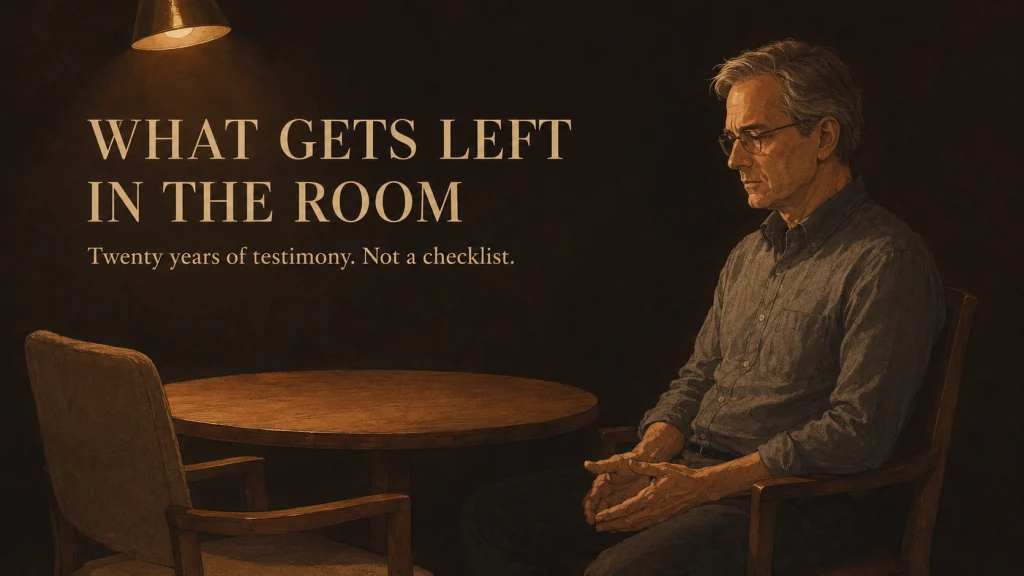
Final Thoughts: What Got Left in the Room
Twenty years of this work did not leave me with answers in the way I expected when I started. It left me with a quieter, more persistent sense of what tends to matter once the performance falls away, and a fair amount of humility about how often I, too, still get distracted by things that will not be what I name first when my own version of that conversation eventually arrives. I have not solved that. I have only become more honest about noticing it.
For readers who want to sit with the harder edge of this directly, I have written separately about what it actually means to think clearly about your own mortality, since the patterns described here only become personally useful once mortality stops being an abstraction. For the grief that often sits on the other side of these conversations, the territory of what grief actually asks of the people left behind covers what happens after the room empties. And for the ordinary moments these patterns kept pointing back toward, I have written more on why small, unremarkable moments tend to matter more than people expect.
FAQs
🕯️ What do dying people actually talk about most?
Relationships, almost always, and faster than I expected even from people who had built considerable careers. The conversations tend to land on one specific day or one specific decision, not on the relationship as a general idea.
💭 What do people regret most at the end of life?
Far more often what they deferred than what they actually did. A postponed visit or a delayed conversation surfaces as regret much more reliably than an afternoon spent on something ordinary.
🪑 Do people near the end talk about their careers?
Less than you might think, and rarely in terms of achievement. Titles and accomplishments tend to fall away from the conversation almost entirely, replaced by a quieter accounting of whether the work connected them to someone, rather than simply filled the hours.
🙏 Does gratitude actually show up at the end of life?
Yes, more often than I expected before I started this work. It rarely looks like relief that things turned out well. It looks more like someone finally noticing the ordinary parts of their life clearly, often for the first time, with no time left to do anything but notice.
📋 Are these lessons the same for everyone who is dying?
No, and I would distrust anyone who claims otherwise. These are patterns I noticed repeat often enough to name, filtered through my own limited attention, not a universal account of what dying teaches every person.