Finding joy when you do not feel like it is not about deciding to look on the bright side, and it is not about distracting yourself from what is actually hard. I watched genuine joy show up in some of the heaviest rooms I ever sat in, and what made it possible was never the absence of pain. This piece looks at what that kind of joy actually looks like during a difficult period, why it is smaller and more specific than the ordinary kind, and how it can exist right alongside the hard thing instead of pretending the hard thing is not there.
Joy in Rooms That Had No Right to Contain It
Some of the most genuine moments of joy I ever witnessed happened in rooms that, by any reasonable account, had no right to contain them. A daughter laughing so hard at a memory of her father that she had to leave the hallway to catch her breath, twenty minutes after the diagnosis that meant he was not coming home. A husband at his wife’s bedside, both of them quietly cracking up over something absurd on the television, in the middle of a week neither of them would have chosen. What made those moments possible was never the absence of pain. It was a brief, specific permission to set the pain down for a moment without pretending it was not still there waiting for them.
That distinction matters for anyone trying to figure out how to find joy when you do not feel like it. The goal is not to replace the difficulty with something brighter. The difficulty is still there. The question worth asking is whether something small and real can exist next to it, even briefly, without requiring you to perform a feeling you do not have.
Why Even a Brief Genuine Moment Is Worth Something
Research on positive emotions during hard periods offers a useful piece of grounding here. Psychologist Barbara Fredrickson’s broaden-and-build theory of positive emotions describes how even brief, genuine positive experiences can temporarily widen a person’s awareness and the range of responses available to them, rather than narrowing focus the way distress typically does. This does not mean a moment of joy erases what is difficult. It means that moment is doing real work, even if it lasts only a few minutes and changes nothing about the underlying situation.
I think this is worth knowing because it gives people permission to stop treating small positive moments as irrelevant or beside the point during a hard stretch. A cup of tea taken slowly. A few minutes of sun on your face. A sentence someone said that landed exactly right. None of these fix anything. None of them are answers to what is actually wrong. But they are genuinely available even inside a difficult period, and the fact that they are small does not mean they do not count.
Why Joy During Hardship Looks Smaller Than the Ordinary Kind
Most advice on finding joy during a hard period falls into one of two categories, and I have never found either one honest. The first is forced positivity: decide to look for the good, choose gratitude, focus on the silver lining. This asks someone to perform a feeling they do not have, and most people can tell the difference between a feeling they are having and a feeling they are manufacturing on command. The second is avoidance: distract yourself, stay busy, do not sit with it too long. This can offer real relief, but it is not joy. It is the absence of the hard thing for a while, which is a different experience entirely.
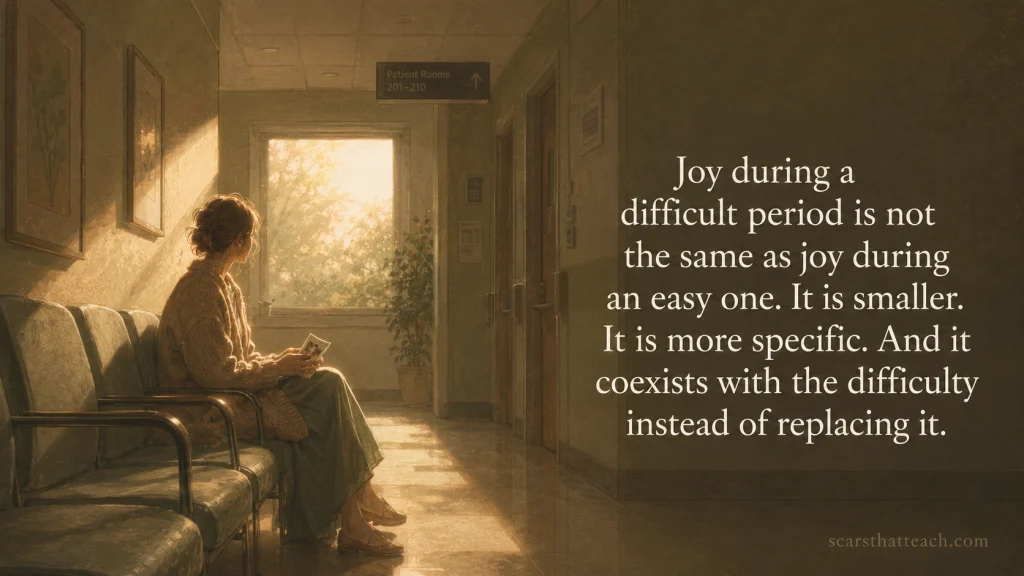
What I have actually watched work is something quieter than either of those. Joy during a difficult period is not the same as joy during an easy one. It is smaller. It is more specific. And critically, it coexists with the difficulty instead of replacing it. The daughter in the hallway was not happy that her father was dying. She was laughing at a real memory, for a real reason, while the dying was still happening exactly as it had been a few minutes before. Both things were true at once. Neither canceled the other out.
- A specific memory that still makes you laugh, even on a day when little else does.
- A particular taste, sound, or texture that briefly takes up your full attention.
- A small kindness from someone, noticed and let in rather than brushed past.
- A moment of physical relief, sun, warmth, quiet, that asks nothing else of you.
- A piece of music or a sentence that lands exactly right for no explainable reason.
None of these require the hard thing to be resolved first. That is the part most advice leaves out, and it is the part that actually matters if you are in the middle of something you cannot fix on a timeline.
What This Is Not, and When It Is Not Enough
It would be dishonest to suggest that small moments of joy are a sufficient response to everything that gets called a hard period. A difficult week is not the same as a sustained inability to feel anything positive at all, and the two should not be treated the same way. If you have gone an extended stretch of time unable to access even brief, genuine positive feeling, no matter the circumstance, that is a different situation than the one this piece is addressing, and it is worth bringing to a professional who can actually assess what is happening rather than trying to talk yourself into noticing a cup of tea.
What is being described here is something more ordinary: a hard stretch, a loss, a frightening diagnosis, a season that is simply heavy, where joy has not disappeared as a capacity but has gone quiet under the weight of what is happening. For that kind of difficulty, small joy is not a fix and was never meant to be one. It is something real, available alongside the hard thing, worth noticing rather than dismissing as beside the point.
Final Thoughts: You Do Not Have to Choose Between the Pain and the Joy
You do not have to resolve what is hard before you are allowed to notice what is briefly good. That permission, more than any technique, is what made joy possible in the hardest rooms I ever sat in. It was never about ignoring the difficulty. It was about letting something small and true exist next to it, for as long as it lasted, without demanding it explain itself or apologize for being there.
For more on what this looks like outside of a hard season specifically, how to savor ordinary moments looks at the same skill applied to everyday life. The wider collection of questions on this subject lives at finding joy in small things, and for words that speak to holding onto something good in the middle of something hard, there is more in happiness quotes.
FAQs
🌤️ How do I find joy when I genuinely do not feel like it?
Look for something small and specific rather than trying to feel better overall. A real memory, a brief sensation, a kind word noticed rather than brushed past. These do not require the hard thing to be resolved first.
🍵 Is it wrong to feel joy during a hard or grieving period?
No. Joy during a difficult period is smaller and more specific than the ordinary kind, and it can exist right alongside grief or hardship without canceling it out. Both things can be true in the same moment.
🚫 Is forcing positivity the same as finding joy?
No. Forced positivity asks you to perform a feeling you do not have. Genuine small joy is something you notice, not something you manufacture on command, and most people can feel the difference between the two.
🧠 Can small moments of joy treat depression?
No. Small moments of joy are a reflection on ordinary hard periods, not a treatment for depression. If you have gone an extended stretch unable to access any genuine positive feeling, that is worth discussing with a professional.
✨ Why does a brief moment of joy actually matter if it does not fix anything?
Research on positive emotions has found that even brief genuine positive experiences can temporarily widen a person’s awareness and available responses. It does not resolve the difficulty, but it does real work in the moment it happens.