Being alone and being lonely are not the same thing, even when they look identical from the outside. The difference is almost never about how much company you have. It is about the quality of the company you keep with yourself. That is something most people have never been taught to think about, let alone develop. This piece is about that distinction, and what it actually takes to settle into aloneness without the anxious edge.
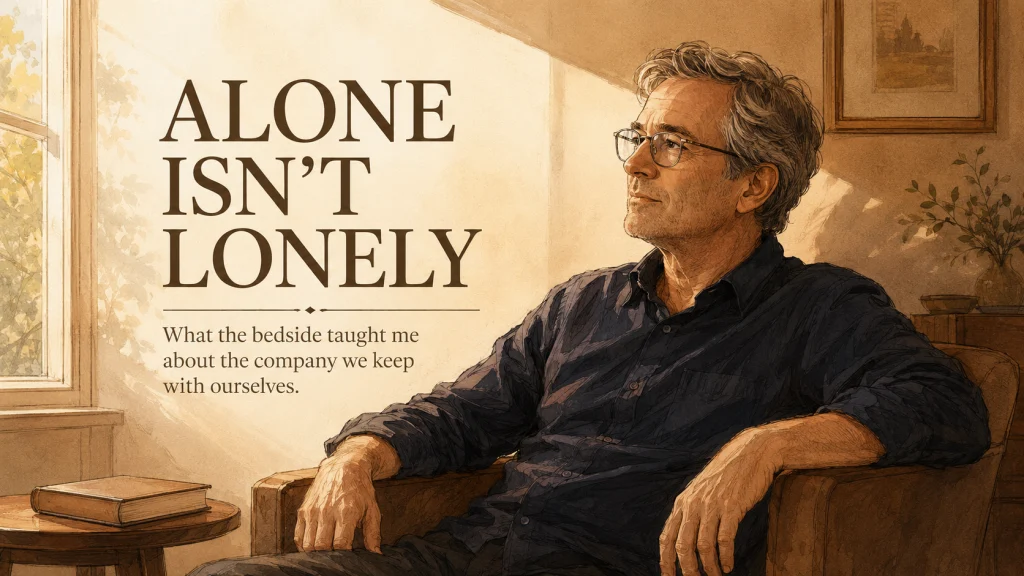
What No One Could See From the Doorway
In hospice work, I sat with people who were alone in every measurable sense, and I sat with others who had a full house around them and were lonelier than anyone I have ever met. The two experiences looked nothing alike on the inside, but from the outside, they could be nearly impossible to tell apart. One person, one room. What filled the room was invisible.
What I noticed, more times than I can count, is that the people who had learned to be genuinely settled in their own company were not people who had found a way to stop wanting connection. They still wanted it. They had just developed something that did not depend on it being available in order to function. The people who had not developed that thing, whether they were alone or surrounded, tended to carry a particular kind of quiet suffering that followed them into every room they entered.
That is the distinction worth making. Not alone versus not alone. But what happens on the inside when the door closes and the other people are gone.
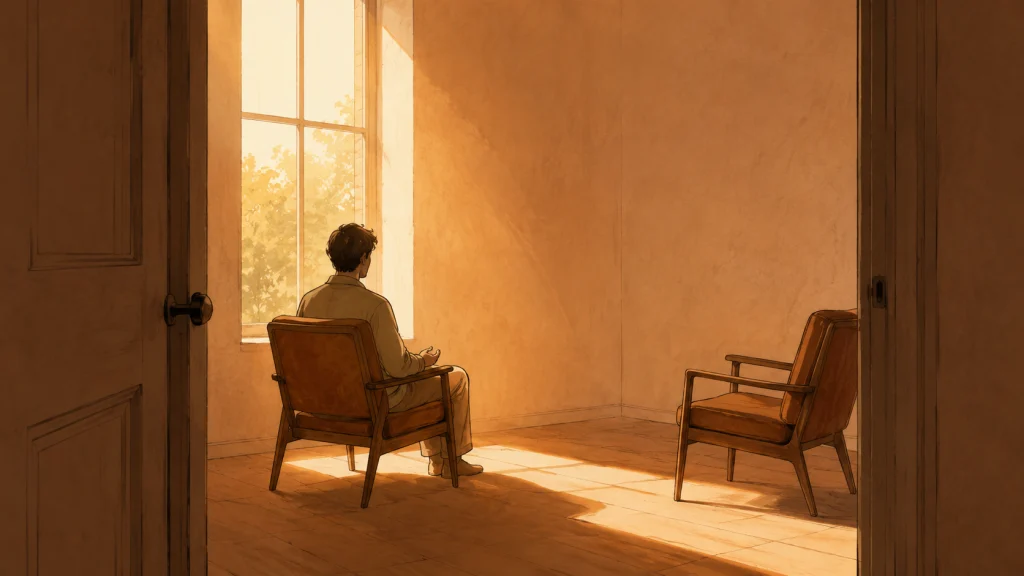
Two Conditions That Sound the Same
Solitude and loneliness are psychologically distinct experiences, even though they can share the same physical circumstances. Loneliness involves a gap, a perceived distance between the connection you want and the connection you have. It is not simply being without people. It is the ache of that absence, the sense that something is missing that should be there. Solitude, by contrast, is aloneness that does not carry that ache. It can be chosen or it can arrive through circumstance, but the key feature is that it does not feel like deprivation.
Research on solitude consistently finds that the ability to be alone without distress is associated with better self-knowledge, stronger emotional regulation, and more creative thinking. This is not because aloneness is inherently superior to connection. Both are genuine human needs. It is because people who can be with themselves without running from the experience have access to something that constant social noise tends to crowd out: their own thoughts, their own rhythms, a clearer sense of what they actually want and feel when no one else is in the room shaping the answer.
The problem is that most people were never taught the difference. They learned to associate being alone with loneliness, because for most of childhood and early adulthood, the two did tend to arrive together. If you were alone, it usually meant you were left out, left behind, or left over. That association is hard to undo, even when the circumstances have changed completely.
What the Generic Version Gets Wrong
The most common advice for people who struggle with being alone is to fill the time. Get a hobby. Join a group. Call a friend. Go somewhere with other people. This advice is not wrong, exactly, but it is aimed at the wrong problem. It treats aloneness as the issue and connection as the solution, which misses the point almost entirely.
The issue is not aloneness. The issue is the relationship you have with yourself when no external input is available to distract you from it. A person who cannot be alone without significant distress does not need more plans. They need to become better company for themselves. That is a different task, and it is the one that almost no one gives them the tools for. Filling the schedule quiets the discomfort temporarily. It does not touch the thing underneath it.
I watched this play out in hospice rooms more than I would like to count. People who had spent decades staying busy, staying social, staying connected, and then found themselves in a bed with fewer options and had to reckon, often for the first time, with what it felt like to simply be with themselves. For some, it was not peaceful. Not because they were bad people or had led wrong lives, but because that particular skill had never been built.
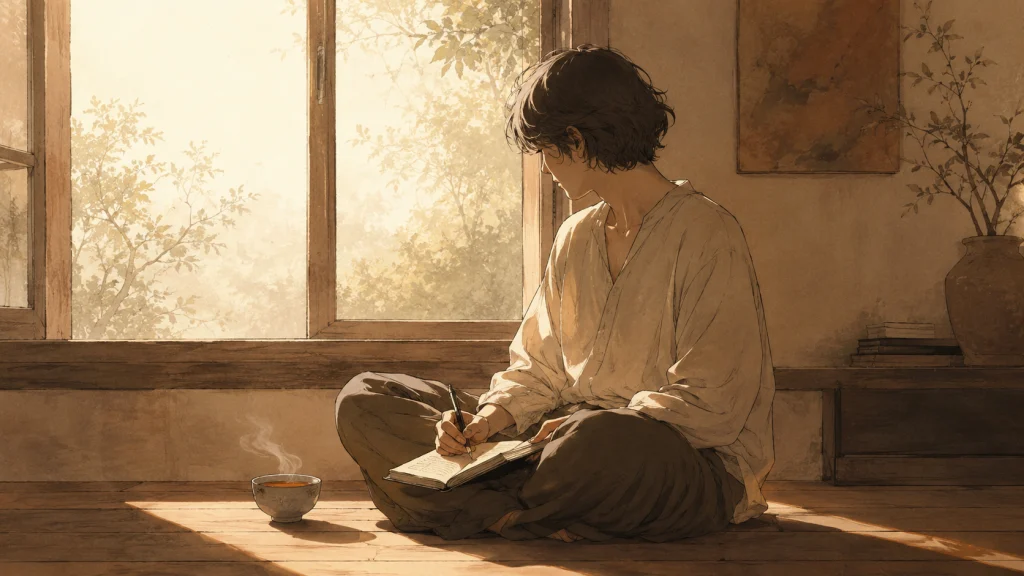
The Company You Keep With Yourself
There is a pattern I saw often enough to stop calling it a coincidence. The people who were most at ease alone, genuinely at ease, not performing contentment but actually settled, tended to have some quality of honest self-regard. Not self-congratulation. Not relentless self-improvement. Just a certain basic willingness to be present to their own experience without immediately needing to change it or escape it. They were, in the simplest terms, decent company for themselves.
This is not a fixed trait. I want to be clear about that. I do not think it is something you either have or do not have from birth. I think it is something that can be developed, with some deliberate effort and some patience for how uncomfortable the early attempts tend to feel. Most people who struggle to be alone find that the first stretch of quiet time is the hardest. The mind reaches for something: a phone, a task, a problem to solve, anything to avoid the stillness. That reaching is not a character flaw. It is just a trained reflex. The question is whether you let it run the room or whether you start, slowly, to sit with it instead.
- Notice what surfaces when the noise stops. Not to fix it, just to see it. Most people find that the thing they were avoiding is not nearly as unbearable as the anticipation of it suggested. The anticipation tends to be louder than the thing itself.
- Give the discomfort somewhere to go. Writing, walking without a destination, sitting somewhere with a long view. Not as productivity, not as self-improvement, but as a way of being present to yourself without the pressure of an audience.
- Stop treating aloneness as a gap to be filled. When you approach it as a problem that needs solving, you stay in the mode of waiting for the next social input. When you approach it as its own kind of time, something different becomes possible.
- Let the quality vary. Some stretches of solitude will feel restoring. Others will feel flat or lonely in a low-grade way. Both are real. Neither tells you that you are doing it wrong.
- Pay attention to what you reach for first. The phone, the television, the task list. Not to stop reaching, but to notice the reflex before it runs. There is information in what you instinctively want to put between yourself and the quiet.
- Do not measure progress against a feeling of peace. The goal is not to feel serene when you are alone. It is to become less frightened of what arises when you are. Those are different targets, and conflating them is what makes people give up early.
None of these are instructions that resolve anything quickly. They are closer to a direction than a destination. The point is not to become someone who prefers solitude to connection. The point is to become someone who is not at the mercy of their own absence of company.
When It Is Not Solitude
Loneliness is not a character failing. I want to say that plainly, because a lot of the framing around solitude and self-sufficiency carries an implicit judgment: if you struggle to be alone, something must be wrong with you. That is not what I observed. What I observed was that some people had circumstances, histories, or nervous systems that made aloneness feel more threatening than it did for others, and that this was not a moral category. It was a condition they were working with.
There is also a version of this that belongs to a different conversation entirely. The kind of loneliness that comes from genuine social isolation, from the felt absence of people who know and see you, is not something that solitude practice resolves. That is an experience of unwanted isolation and what it does to a person over time, and it deserves to be addressed on its own terms, not reframed as a mindset problem.
What this piece is about is narrower than that. It is about the person who is alone, by choice or by circumstance, and wants to relate to that aloneness without the anxious edge. Not because connection is unavailable or unimportant, but because the quality of your own company is something you carry everywhere, including into the rooms where other people are present.

The Inner Life Has Weight
Two people can live what looks, from the outside, like the same kind of life. Similar relationships, similar schedules, similar amounts of time alone. But the experience of that life, whether it feels full or hollow, settled or anxious, meaningful or arbitrary, is almost entirely determined by what is happening on the inside. That inner territory is something most people give very little deliberate attention to. They tend to it indirectly, through busyness, through social input, through the accumulated noise of a well-filled calendar. And that works, until the calendar empties and the noise stops and something has to be there instead.
Learning to be with yourself is, in some sense, the beginning of knowing what is actually there. This connects to something larger than the question of solitude alone. People who have done that work, who have spent time with their own thoughts and fears and preferences without immediately needing to perform them for an audience, tend to have a clearer relationship with the questions that eventually come for everyone, including what it means to face your own mortality without the noise of distraction available to drown it out.
That is not an argument for solitude as a spiritual practice. It is just an observation about what tends to be present in people who have made some peace with being alone. They know themselves somewhat better. That turns out to matter more than most people expect.
Final Thoughts: What You Are Actually Building
If you have read this far, you are probably someone for whom being alone is a real question, not an abstract one. Maybe it arrived by choice, or maybe the circumstances arranged themselves and left you with more quiet time than you were prepared for. Either way, the work is the same: developing a relationship with yourself that does not require constant external input to hold together.
That is not the same as deciding you do not need people. You do. Most people do. The goal is not to become self-sufficient in some cold, sealed-off way. It is to stop being afraid of the door closing and the quiet settling in. There is a version of that quiet that is not empty. It takes time to find it, and the finding is not linear, but it is available to most people willing to stop treating every moment of aloneness as a problem that needs solving before it can be sat with.
The two decades I spent in those rooms did not leave me with certainty about much. But they left me fairly certain of this: the people who had genuinely settled into their own company, who could sit in silence without needing to escape it, were not lonelier than others. On the whole, they were less so. That is not nothing.
FAQs
🤔 What is the difference between solitude and loneliness?
Solitude is aloneness without the ache of deprivation. Loneliness is the gap between the connection you want and the connection you have. You can be alone and not lonely, and you can be surrounded by people and deeply lonely. The physical circumstance is the same; the inner experience is entirely different.
😟 Why do I feel lonely even when I choose to be alone?
Choosing to be alone does not automatically make the experience feel settled. If the relationship you have with yourself is tense or avoidant, aloneness will tend to surface that tension no matter the circumstances. That is not a failure. It is information about where the actual work is.
📱 Is it normal to always want distraction when I am alone?
Yes. The reflex to reach for something when the quiet settles in is almost universal. It does not mean something is wrong with you. It means the reflex has been well-trained. The question is whether you let it run every moment, or whether you occasionally practice sitting with the discomfort instead of immediately filling it.
🌱 Can you actually learn to enjoy being alone, or is it a fixed trait?
It is not fixed. The capacity to be alone without distress is something most people can develop, though it takes time and the early attempts tend to feel uncomfortable. What changes is not that aloneness stops feeling unfamiliar. It is that the unfamiliarity stops being something you need to escape immediately.
💬 How do I know if my aloneness has crossed into real loneliness that needs attention?
If the aloneness is consistently painful, if there is a sustained sense that no one knows or sees you, and if it is affecting your daily functioning or mood over time, that is worth taking seriously. That is a different experience from the ordinary discomfort of learning to be alone, and it may call for something beyond personal practice to address.