
Money is one of the most reliably difficult topics to discuss, even with people close to you, even about your own finances. The discomfort is not just social awkwardness. It runs deeper than that. Talking about money reveals what you have, what you value, and how you see yourself in relation to other people, all at once, in a way that almost no other practical topic does. That combination is what makes it feel so charged, and why the usual advice to just talk about it more openly tends to miss the point.

The Subject That Always Said Too Much
In my years as a chaplain, I sat with people on the edge of many kinds of difficult conversations. Some were about relationships that had broken down. Some were about things left undone or unsaid. A few were about death, directly and practically. Of all the subjects people found hard to raise, money was among the most reliably difficult, and the difficulty was different in kind from the others.
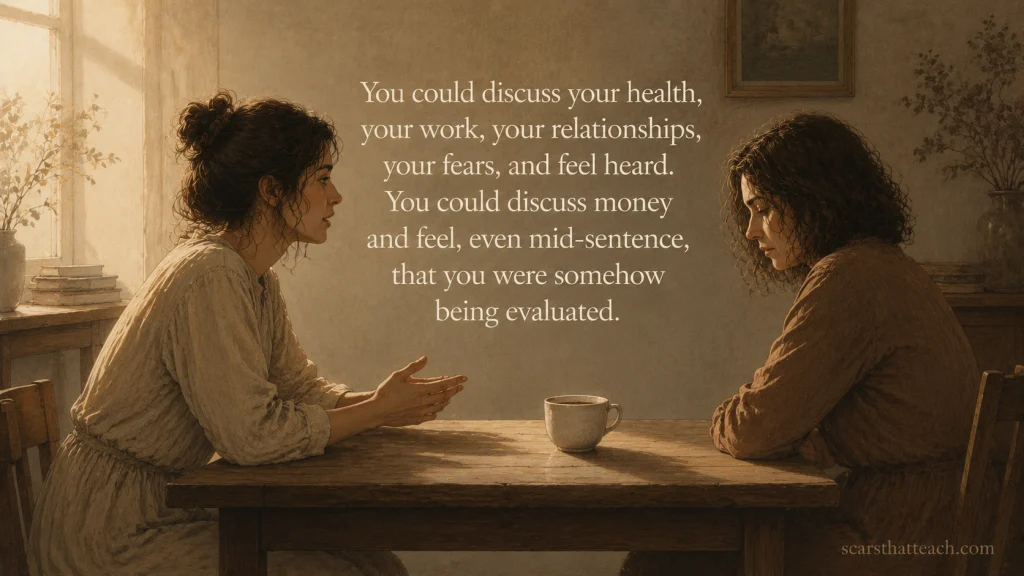
It was not that people did not want to talk about it. Most of them did, at least in some sense. It was that talking about money always seemed to say something about them they had not intended to say. What that something was, they were not always sure. But they felt it. A kind of exposure that other practical topics did not produce. You could discuss your health, your work, your relationships, your fears, and feel, at the end of it, that you had been heard. You could discuss money and feel, even mid-sentence, that you were somehow being evaluated. Not by the other person, necessarily. By something else. By whatever internal accounting had always been running in the background.
That feeling is not irrational. It has a specific explanation, and understanding it does not make it disappear, but it does make it easier to recognize what is actually happening when a money conversation goes sideways or never gets started.
Why Money Feels Different From Other Practical Topics
Most subjects that are difficult to discuss are difficult for reasons that are clearly emotional: grief, conflict, shame about something specific. Money is unusual because it looks like a practical subject and behaves like an emotional one. You can discuss your salary as a set of numbers and still feel that you have said something deeply personal. You can ask a friend about their finances and feel, immediately, that you have crossed a line you did not mean to cross. The numbers are not the point. The numbers stand in for something else.
That something else is, broadly, identity. Money is connected, in most people’s internal accounting, to worth, to security, to status, and to how they compare to the people around them. Not because they chose to connect those things, but because the connections were built over years of absorbing how the people around them talked, behaved, and felt about money. By the time most people are adults, money is not just a practical resource. It is evidence of something. Of how hard you have worked, or how smart you are, or how much you matter, or whether you are going to be okay. Discussing it means potentially revealing that evidence, which means potentially being evaluated on those terms.
That is a much higher stake than the conversation about numbers suggests. It is why a simple question about what someone earns can feel invasive in a way that a question about their health does not. Health is something that happens to you. Money, in the cultural framing most people have absorbed, is something you have earned, or failed to earn, or managed, or mismanaged. The numbers are never just numbers. They are a verdict someone might read.
The Comparison Problem
Part of what makes money talk specifically uncomfortable, rather than just personal, is that it almost always invites comparison, and comparison about money is almost never neutral. If you earn more than the person you are talking to, the conversation carries a kind of asymmetry that is hard to navigate. If you earn less, the exposure feels sharper still. Even when the numbers are similar, the differences in what those numbers represent, in spending patterns, in savings, in debt, in what you choose to prioritize, become visible in a way that feels like it says something about who you are and what you care about.
Most people are aware of this dynamic, even if they have not put it in those terms. They avoid money conversations not because they have a rule against them but because they have learned, through experience, that those conversations have a way of producing that uncomfortable sense of being seen and ranked. Even when the ranking is entirely internal, even when the other person has said nothing evaluative, the self-evaluation happens anyway.
The research on money beliefs supports this. Work cited by integrative-psych.org and regions.com consistently points to the emotional loading of money as the mechanism behind financial avoidance, overspending, and secrecy. These behaviors are not irrational. They are protective responses to the fact that money territory is identity territory, and exposing your financial reality means exposing part of how you see yourself and fear being seen by others.

What the Discomfort Is Actually Protecting
The silence around money is not only about not wanting to be evaluated. It is also about not wanting to look too closely at what your relationship to money says about you, including to yourself. This is the layer that most explanations of money taboo skip.
Most people carry what researchers call money scripts, largely unconscious beliefs about what money means and what having or not having it says about a person. These beliefs were formed early, absorbed from the environment rather than consciously chosen, and they have been operating below the level of examination ever since. When a money conversation threatens to make those scripts visible, the discomfort is partly the discomfort of potential revelation to others and partly the discomfort of potential revelation to yourself.
The person who avoids looking at their bank statements is not necessarily avoiding the numbers. They may be avoiding the story the numbers tell about whether they are managing their life well, whether they are on track, whether they are the kind of person they believe they should be. The person who becomes evasive when money comes up in conversation may not be hiding specific information. They may be protecting a self-image that feels fragile enough that scrutiny, even gentle scrutiny, feels dangerous.
These are not character flaws. They are predictable responses to the fact that money has become a proxy for self-worth in most of the cultural environments most people live in. When something is that freighted, silence is a reasonable defense. The question is whether the defense is actually serving you, or whether it is keeping you from conversations and examinations that would, in the end, be more useful than the avoidance. Where those scripts came from, and how scarcity thinking in particular takes hold, is what how scarcity thinking about money forms and operates looks at specifically. And if what sits underneath this discomfort feels like a broader set of money beliefs worth examining, what shapes how people think about money covers the fuller picture.

Final Thoughts: What You Are Actually Protecting
The discomfort that money conversations produce is real, and it is not a sign that something is wrong with you. It is a sign that you are human, and that you live in a culture that has spent a long time using money as a measure of things it cannot actually measure. Worth is not money. Security is not a number. How well you are doing as a person is not visible in your bank account, even though something in most people responds as if it were.
What I noticed, over years of sitting with people at the edges of their lives, is that the ones who had found the most peace around money, which was not many, had usually found it by separating the practical fact of money from the identity-weight it had accumulated. Not quickly, and not through a conversation or a realization, but through a gradual examination of what money had come to mean in their specific history, and a decision, more implicit than explicit, to hold that meaning a little more loosely. That process is slow and uneven. But the discomfort of money conversations is one of the more reliable signs that it might be worth starting. People who have done it tend to describe what it actually required in ways that frameworks do not, and what people who have changed something difficult about themselves actually say is worth reading with that in mind.
FAQs
🤐 Why is talking about money so uncomfortable?
Because money is not just a practical topic. It is tied to worth, identity, status, and security in most people’s internal accounting. Discussing it means potentially revealing how you see yourself and how you measure up relative to others, which is a much higher stake than the numbers alone suggest.
🔍 Why is money considered taboo to talk about?
The taboo is partly cultural and partly personal. Culturally, money has become a proxy for worth in most of the environments most people grow up in. Personally, money conversations risk exposing beliefs about yourself that have been operating below the surface for a long time, and that exposure feels dangerous even when nothing explicitly evaluative is being said.
😔 Why do I feel ashamed talking about money even with people I trust?
Because the shame is not about the specific numbers or the specific person. It is about what the numbers feel like they say about you. Money conversations have a way of making internal self-evaluations visible, and most people are carrying beliefs about what their financial situation says about their worth that they have not examined directly.
💬 Why does asking someone about money feel rude?
Because the question is rarely experienced as being just about money. It is experienced as a question about worth, effort, success, and comparison, all at once. That is a lot of weight for a practical question, which is why the social norm around not asking developed in the first place.
🧠 Is avoiding money conversations a problem?
Not always. Avoidance is a reasonable response to something that feels risky. The question worth asking is whether the avoidance is protecting you from something genuinely harmful or keeping you from conversations and examinations that would actually be useful. Those are different situations with different answers.