
People want one answer for why hardworking people sometimes fail, and the honest one rarely fits in a sentence. Effort matters, and it is not the whole story. Timing, who you happened to know, where you started financially, and a handful of moments that could have gone either way all play a real part in outcomes most people credit entirely to character. I have watched the difference between someone who could make peace with a failure and someone who could not, and it rarely came down to who worked harder.

The Most Honest Answer I Ever Heard
Why do hardworking people sometimes fail is a question I heard in some form more times than I can count, usually from someone trying to locate the exact place they had personally fallen short. The most honest answer I ever heard to that question, from a man near the end of his life who had lost a business he built from nothing, was not “I did not work hard enough.” He had worked hard enough. What he said instead was calm and specific. He named the supplier who folded six months before his biggest contract, the loan rate that doubled the year he needed it lowest, and the competitor who happened to have a cousin on the city council. None of it was effort. All of it was true, and none of it could have been changed by trying harder.
That answer stayed with me because it was the rare one that did not flatter or condemn him. He was not letting himself off the hook entirely, and he was not pretending the failure proved something deficient about his character. He was just describing what had actually happened, in full, instead of the shortened version everyone else was willing to accept.
Why Good Workers Fail Gets Blamed on the Person First
The default explanation for failure, almost everywhere it gets discussed, is individual. If someone works hard and the result does not come, the assumption is usually that the effort was insufficient, the approach was wrong, or the ability simply was not there. This framing shows up in career advice, in family conversations, and in the quiet story people tell themselves at two in the morning. It has the advantage of being simple and the disadvantage of being incomplete.
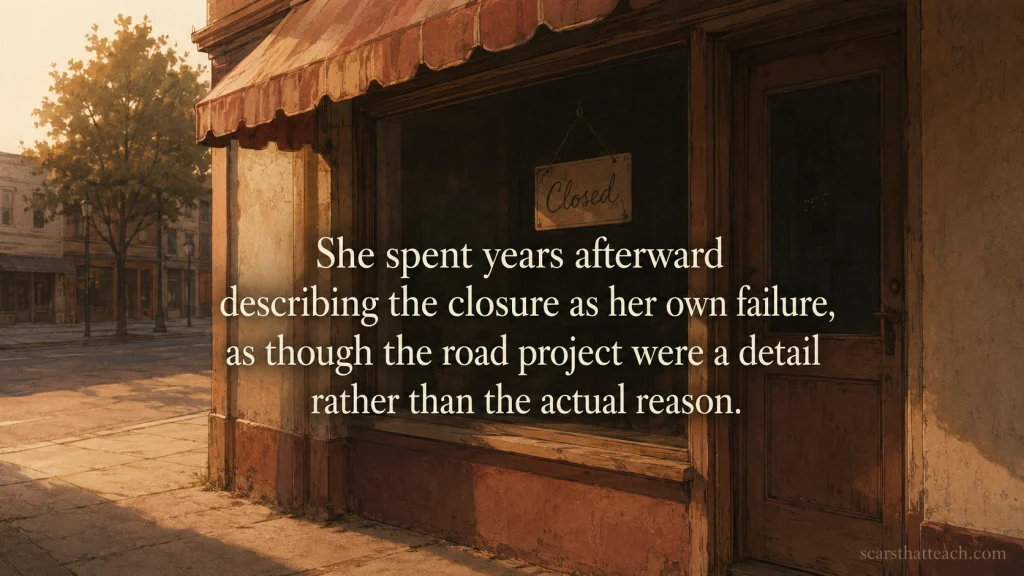
I sat with a woman who had run a small bakery for eleven years before closing it. Her recipes were good. Her hours were brutal and consistent. By every measure of personal effort, she had done what was asked of her. What she had not had was the capital to survive eighteen months of a road construction project that cut off foot traffic to her block, something a better-funded competitor two streets over absorbed without much trouble. She spent years afterward describing the closure as her own failure, as though the road project were a detail rather than the actual reason. That is the individual framing doing exactly what it tends to do, taking a complicated outcome and compressing it into a verdict on one person’s effort, the same compression behind a lot of quotes about hard work and persistence that leave out everything but the willpower.
Why Does Hard Work Not Always Pay Off
The honest, multi-factor picture includes effort, but it does not stop there. Economist Robert Frank documented something specific about competitive domains, where many people are similarly talented and similarly hardworking: in those situations, a single random moment, who happened to be in the room, whose proposal landed on the right desk on the right day, can determine which equally capable person ends up the visible success. The work is necessary, but in close competitions it is rarely sufficient on its own to explain who comes out ahead, which is really the heart of whether hard work is ever enough on its own. Effort and failure are connected, but the connection is not a straight line.
Structural starting points matter too, in ways that are easy to underweight from the outside. A person who starts with family money to absorb a bad year, or a network that hands them their first three clients, is not working harder than someone without those things. They are working from a different position on the board, and that position is most of what people are actually pointing to when they talk about the role luck plays in success. None of this means individual effort is irrelevant. It means effort operates inside a set of conditions that were already in place before the first hour of work went in, and pretending those conditions do not exist does not make the picture more accurate, only simpler.
A few of the factors worth separating out from effort itself:
- Timing: whether the broader conditions, the market, the moment, the competing options, happened to favor the specific thing being attempted.
- Positioning: who you already knew, what resources you already had, and how much room there was to absorb a setback without it ending the attempt.
- Random variation: a single decision made by someone else, on a day you had no part of, that could have gone a different way with no change in your own effort.
- Structural barriers: conditions built into a system before you arrived in it, which apply unevenly regardless of how hard any individual works against them.
The common mistake here is treating this list as an excuse generator, a way to explain away every failure without looking at what was actually within your control. That is not what it is for. The point is not to remove effort from the equation. It is to stop treating effort as the entire equation, which is a different and more accurate thing to believe.

What This Actually Changes for You
None of this is meant to tell you that your specific failure was entirely bad luck, or entirely a structural barrier, or entirely something you could not have done differently. I do not know your situation well enough to say that, and neither does anyone selling you a single tidy explanation. What I can tell you is that the question worth asking after a failure is rarely “did I work hard enough.” It is closer to “what was actually true here, all of it, including the parts that had nothing to do with me.” That is a harder question to sit with, because it does not produce a clean verdict, but it tends to be closer to what actually happened.
This distinction matters for what you do next, too. If you decide the entire explanation was your effort, the natural response is to work even harder at the same thing, which sometimes helps and sometimes just exhausts a person doing something that was never going to work regardless of effort. If you decide the entire explanation was bad luck or an unfair system, the natural response is to stop trying altogether, which forecloses on the part that genuinely was within your control. The accurate picture sits between those two, asking honestly which parts were yours and which parts were not, and acting differently on each. That distinction is also most of what determines how someone keeps working when results are not coming, since the reason for continuing changes depending on which parts of the failure were actually within reach.
Final Thoughts: The Whole Story, Not the Short Version
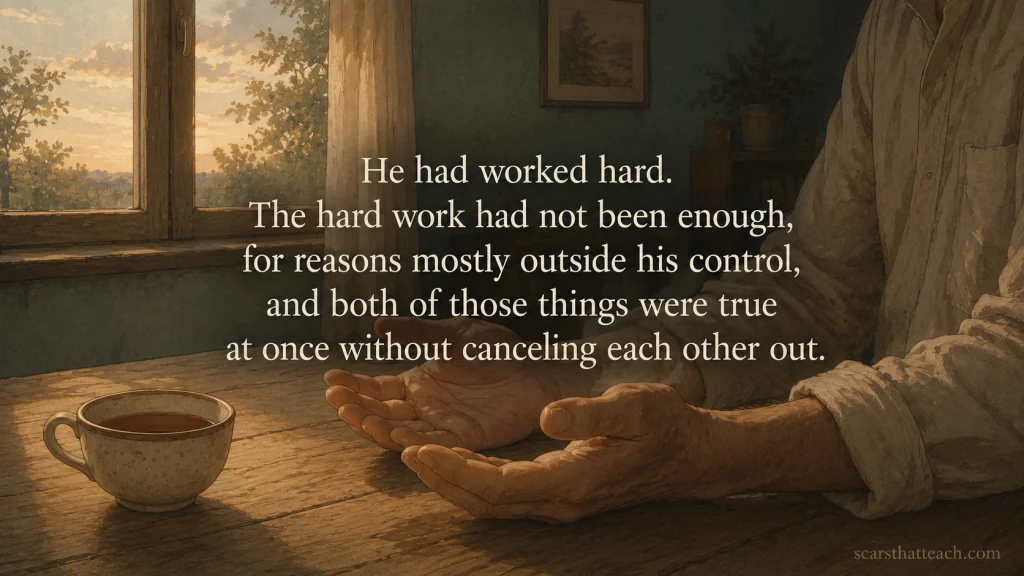
The man I mentioned earlier did not become bitter after naming everything that had been working against him. If anything, naming it accurately seemed to be what let him stop carrying the failure as a verdict on his own worth. He had worked hard. The hard work had not been enough, for reasons mostly outside his control, and both of those things were true at once without canceling each other out. If you are still sorting through whether hard work reliably pays off in your own situation, that is worth sitting with honestly rather than answering with a slogan either direction tends to offer.
FAQs
🧱 Why do hardworking people sometimes fail?
Effort matters, but timing, financial starting position, network access, and random moments outside anyone’s control also shape outcomes. Failure despite real effort usually involves several of these factors at once, not a single missing ingredient.
🎲 Is failure mostly about luck?
Not entirely, and not never. In competitive situations where many people are similarly skilled and similarly hardworking, a small amount of luck at a key moment can decide the outcome, but luck alone rarely explains every failure.
🛠️ Does this mean my effort did not matter?
No. Effort is still a necessary part of most outcomes. The point is that it is rarely the only part, and treating it as the only part can make an honest look at failure harder, not easier.
📉 Why does hard work not always pay off?
Hard work operates inside conditions, market timing, financial cushion, who you know, that were already in place before the work started. Those conditions can limit what even consistent effort is able to produce.
🔁 What should I do differently after a failure like this?
Try to name what was actually within your control and what was not, specifically rather than generally. That separation tends to be more useful than deciding the whole failure was either entirely your fault or entirely bad luck.