
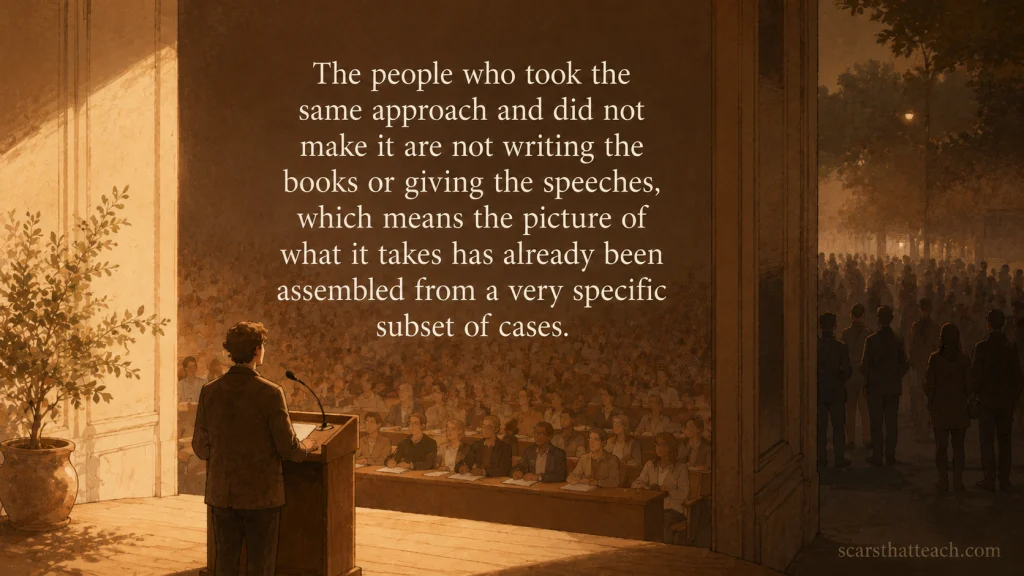
Survivorship bias describes why the success stories we hear are not a representative sample of everyone who tried: we only hear from the people who succeeded. That filtering shapes the advice given about what success requires, usually without anyone acknowledging that it is happening. The people who took the same approach and did not make it are not writing the books or giving the speeches, which means the picture of “what it takes” has already been assembled from a very specific subset of cases.

What the Encouraging Stories Leave Out
The relationship between survivorship bias and success is not complicated once you see it, but most people are never shown it explicitly, which is part of what makes it so durable. The advice built on top of it tends to feel solid because the examples used to support it are real. Someone did persist and succeed. Someone did bet everything on one idea and come out ahead. What those stories leave out is everything that would tell you how to think about the odds.
I noticed something across many years of sitting with people near the end of their lives. When they told me their own stories, they told the full version, the part where the outcome was still uncertain, where they had made decisions without knowing how things would turn out. But when those same people described the stories that had shaped them, the ones told to them as examples of what was possible, those stories almost always began after the difficulty had been resolved. The lesson started at the point where the narrator knew they were going to be all right. The most instructive part, the part where they were not yet all right and did not know if they would be, had been edited out before the story became encouraging.
That editing is not malicious. It is almost automatic. A resolved story has a shape. An unresolved one is harder to tell and harder to sit with. But the consequence of that editing, accumulated across every success story a person hears over a lifetime, is a picture of the world in which the difficult middle always leads somewhere. That is not what the evidence shows.
Why the People Who Failed Are Not in the Room
The plainest way to put it is this: when you observe only the cases that survived a filtering process, you draw conclusions based on a sample that has already been selected for a particular outcome. In the context of success stories, the filter is success itself. The people whose stories you hear about starting companies, writing books, pursuing unconventional paths and making them work are, by definition, the people for whom it worked. The much larger group of people who tried similar things and did not succeed are statistically underrepresented in the examples you encounter, not because their experiences are less real or less instructive, but because there are fewer platforms available to them and fewer reasons for anyone to seek out what they learned.
This is not a subtle distortion. People who succeed write memoirs. They give commencement speeches. They are interviewed about their methods and their mindsets. People who fail at the same endeavors, taking comparable approaches and working comparable hours, do not tend to get those invitations. The result is that the observable evidence about what produces success is heavily weighted toward cases where it did, which tells you considerably less than it appears to about cases where it did not, and there are almost always more of those. The question of whether hard work reliably produces the outcomes we expect is one that survivorship bias makes genuinely harder to answer from anecdote alone.
The mechanism runs deeper than the missing examples alone, too. When an approach produces a successful outcome, the person who used that approach tends to attribute their success to the approach itself. When the same approach produces a failed outcome, the person who used it tends to assume they executed it incorrectly. This means the feedback loop from experience consistently reinforces the belief that the approach works, independent of whether the approach was actually the decisive variable.
What the Missing Cases Do to the Advice
The practical consequence of filtering success stories through survivorship is that the people receiving those stories consistently underestimate two things: the base rate of failure for any given approach, and the role played by factors outside the individual’s control in the cases that did succeed. Both of those underestimates matter, and they compound each other.
On the first: if the stories you hear about starting a business all come from people whose businesses survived, you have no easy way to know from those stories how often businesses of that kind fail. The example is proof that it is possible, which is not the same as proof that it is probable, or even common. Most of what circulates as motivational thinking about effort and outcome uses examples of the possible to imply conclusions about the probable, and the shift between those two is where much of the distortion lives.
On the second: research into competitive domains has found that the relationship between individual talent or effort and eventual success is weaker than most success narratives suggest, and that random factors, being in a particular place at a particular time, having access to a particular resource or connection, occupying a particular market position before others do, account for a larger share of outcomes than effort-based accounts tend to acknowledge. A simulation study published on arxiv.org found that in competitive environments, moderately talented individuals with favorable chance events consistently outperformed highly talented individuals with unfavorable ones. The researchers were not arguing that talent or effort do not matter. They were arguing that the effect of uncontrolled external factors on outcomes is systematically underweighted in how we understand success.
Effort still matters in all of this. What survivorship bias identifies is not that effort is irrelevant, but that the stories used to describe what effort produces have been filtered through a process that makes it look more determinative than it is, and luck look less consequential than it was.
Survivorship Bias Examples You May Recognize
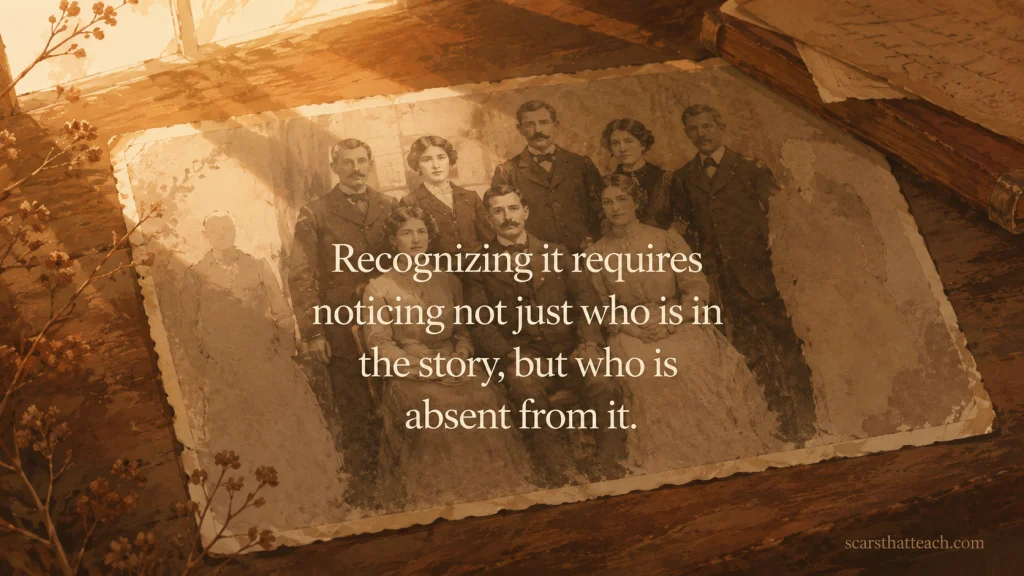
Survivorship bias does not announce itself. It tends to feel like evidence, because the examples are real and the people sharing them are sincere. Recognizing it requires noticing not just who is in the story, but who is absent from it.
A few forms it takes in success advice:
- “They never gave up, and eventually it worked.” This is almost certainly true of the person being described. What the story does not include is an account of everyone who also never gave up and did not get the same result. Persistence is real and it matters. Whether it is the decisive variable in any given case is a separate question.
- “They started with nothing.” Starting with limited resources and succeeding is possible and it happens. Stories about people who started with nothing and failed are harder to find not because they are rare, but because they do not become stories in the same way. The filter removes them before they reach you.
- “They followed their passion.” Some people who followed their passion built something that worked. The people who followed their passion and did not build something that worked tend not to be the examples held up to illustrate what following your passion produces.
- “They just decided to believe it would work.” Confidence and conviction are genuine assets in many situations. They are also present in cases that do not work out. Mindset stories drawn from survivors will consistently overrepresent the cases where the mindset correlated with success, and underrepresent the cases where it did not.
- “Everyone told them it was impossible.” Some unconventional bets pay off. Many more do not. The ones that do get retold as proof that conventional wisdom was wrong. The ones that do not tend not to get retold at all.
The thing people most commonly get wrong when they encounter this idea is assuming it means successful people were only lucky, or that their effort and decisions did not matter. That is not what the bias identifies. It identifies a gap in the sample from which we draw conclusions, not a verdict on any individual case. Whether hard work was necessary for a given success is usually unknowable from the success story alone. The role luck plays in success sits alongside this question and is worth reading for the parts of the picture survivorship bias does not directly address.

Final Thoughts: A Calibration, Not a Conclusion
Understanding survivorship bias does not mean concluding that effort is pointless or that outcomes are random. The people who made it to the examples you are given did work hard, in most cases. They did make decisions that mattered. Acknowledging the bias is not the same as discounting what they did.
What it does is adjust the frame around the evidence. It means treating a success story as proof that a particular outcome is possible, rather than proof that a particular approach reliably produces it, and accounting for the cases that were removed from the sample before the story reached you. Whether hard work is enough on its own is a question that gets distorted when the examples used to answer it have already been filtered for success, which is exactly the gap this frame is meant to correct.
I sat with enough people at the end of their lives to know that the most honest and useful thing anyone can say about this is something most success stories are not built to say: it matters, and it is not sufficient, and both of those things can be true at the same time. Knowing that does not make trying less worthwhile. It makes the trying more honest.
FAQs
🔍 What is survivorship bias in simple terms?
Survivorship bias is what happens when you only observe the cases that made it through a filtering process and miss the ones that did not. In success stories, the filter is success itself: you hear from the people who succeeded, not from the much larger group who tried similar things and did not. The conclusions you draw from that filtered sample will consistently overestimate how predictable or replicable the successful outcome is.
📚 Why are success stories misleading?
Because they are drawn from a sample that has already been selected for a particular outcome. When every example you hear about an approach comes from someone for whom the approach worked, you have no easy way to know from those examples how often it does not work. The stories are real. The sample they represent is not.
🎲 Does survivorship bias mean luck is more important than hard work?
Not exactly. It means the examples used to describe what hard work produces have been filtered in a way that makes hard work look more determinative than the full picture supports. Effort matters. So do factors outside your control. Survivorship bias is not an argument that luck explains everything. It is an argument that luck is systematically underrepresented in the stories told about success.
🧠 How do I recognize survivorship bias when I hear it?
The clearest signal is when an approach is treated as validated by the fact that someone succeeded using it, without any accounting for how often people who used the same approach did not. Ask who is absent from the example. The cases that were filtered out before the story reached you are usually the ones that would most change how you read it.
💭 Should survivorship bias make me less likely to try?
No. It should make you more accurate about what you are trying in. Understanding that the odds are not what success stories imply is useful information, not a reason to stop. The point is calibration: knowing that an outcome is uncertain is different from knowing it is impossible, and most things worth trying sit somewhere in between.