
Hard work is a genuine predictor of competence and a necessary condition for significant outcomes in almost any domain. The research also shows that in competitive fields, it is not sufficient on its own. Economist Robert Frank’s work at Cornell University found that among the many talented, hardworking people competing for the same outcomes, luck and circumstance play a larger role than most people are comfortable acknowledging in determining who actually gets there. That is a more honest answer than the one most people receive.

The Question Nobody Wants to Ask Out Loud
In my years of hospice work I sat with people who had built their lives around the belief that effort was the variable that mattered most. Many of them had worked extremely hard. The ones who had worked hard and still not arrived at the outcome they had oriented their lives toward were not, in my experience, the ones who gave up soonest. They were sometimes the ones who held on longest, because the belief that effort is sufficient is also a belief that more effort can always close the gap. The question they eventually came to, usually after a long time and usually reluctantly, was not whether they had tried hard enough. It was whether trying hard enough had ever been the complete answer in the first place.
Is hard work always enough? The research has a position on this, and it is worth knowing what it actually says rather than the version that tends to circulate in places built around motivation.

What the Research Actually Confirms About Hard Work
The research on effort and success is consistent on one point: hard work matters. Across competitive domains, the people who reach significant levels of achievement are, without exception, highly hardworking. There is no credible evidence for outcomes of that kind being reached without sustained effort. Competence develops through practice and accumulated experience. Skills compound. The relationship between input and output is real, and it operates in the direction people expect.
Hard work also matters because it shapes the quality of what someone produces, the depth of their understanding, and their ability to respond to difficulty. A person who has worked seriously at something for long enough develops capacities that are genuinely different from someone who has not. That is not nothing. The research does not dispute any of this, and neither does the more careful version of what luck and circumstance actually contribute.
Where the research gets more precise, and where the common framing becomes less accurate, is in the claim that hard work is not just necessary but sufficient. That is a different proposition, and it is the one that does not hold up well under examination.
What Robert Frank’s Research Found
Robert Frank, an economist at Cornell University, examined the question of what separates the people who succeed in competitive fields from the many others who are equally talented and hardworking and do not. His findings, detailed in his 2016 book reviewed by Greater Good Magazine, pointed to a conclusion that most success narratives quietly omit: in genuinely competitive domains, luck and timing play a significant role in determining which of many qualified candidates ends up where.
Frank’s position is careful. He is not arguing that luck replaces effort. He is arguing that effort is a necessary condition and not a sufficient one. No one reaches significant achievement in a competitive field without hard work and talent. That part of the meritocratic story is accurate. But in most competitive fields, there are far more hardworking, talented people than there are outcomes to go around. Among that pool, what separates the ones who get there from the ones who do not is not reliably a gap in effort or ability. It is often a matter of circumstances, timing, and the kind of fortunate contingencies that do not appear in most accounts of success because the people telling those accounts understandably want to credit what they did rather than what happened to them.
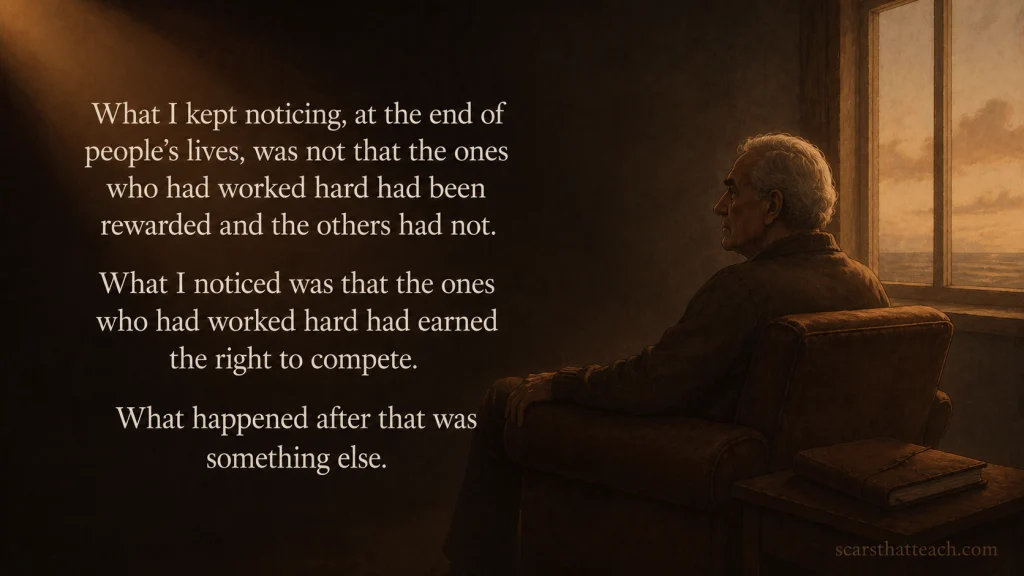
“What I kept noticing, at the end of people’s lives, was not that the ones who had worked hard had been rewarded and the others had not. What I noticed was that the ones who had worked hard had earned the right to compete. What happened after that was something else.”
Frank points out that the word luck tends to make people defensive because it sounds like it is dismissing what they built. But what he means by luck is more specific than randomness. In competitive fields, luck encompasses things like:
- Timing: entering a market, a profession, or a field when conditions are favorable rather than saturated or contracting.
- Geography and access: being physically or socially near the people and opportunities that matter in a given domain.
- Being seen: having someone in a position to open a door encounter your work at the right moment and make a decision in your favor.
- Health and continuity: not having the kinds of personal disruptions, whether illness, family emergency, or financial pressure, that interrupt compounding effort at a critical point.
- Fit with the current moment: having a skill set, approach, or style that happens to match what the field currently values, regardless of whether that set is objectively superior to others.
None of these are things that effort controls. All of them interact with effort to determine outcomes. The necessary-but-not-sufficient framing is not a comfort prize for people who did not work hard enough. It is a more accurate description of how competitive fields actually operate.
What This Is Not Saying
The honest answer to whether hard work is enough for success is not an argument for working less, and it is not a claim that outcomes are random or that effort is meaningless. Frank’s research is clear that hard work is a genuine prerequisite. Removing effort from the equation does not produce different outcomes through luck alone. It produces no outcomes of significance at all.
What the research is saying is something more specific: that effort is necessary but does not guarantee the outcome you are working toward, because in competitive fields you are not the only person working hard. The variable you control is your own effort and preparation. You do not control the timing, the circumstances, or whether the right person sees your work at the right moment. Understanding that distinction is not demotivating unless you were relying on the belief that effort alone is sufficient to maintain the will to continue. If the belief in effort-as-sufficient was load-bearing for you, the more precise version will be uncomfortable. It will also be harder to dismiss when things do not go the way the simpler version promised they would.
If the question driving this for you is specifically about people who work hard and do not get there, why hardworking people sometimes fail takes that question more directly. And if you are thinking through the role that circumstance specifically plays, the role of luck in success covers that territory in more depth.

Final Thoughts: A Harder Answer Than the One That Circulates
The people I sat with who had worked hard for outcomes they did not reach were not people who had failed at something simple. They had done what the available wisdom told them to do. They had applied effort consistently and with genuine commitment. What had not been made available to them, usually, was the more accurate framing: that among the many people doing exactly what they were doing, the distribution of outcomes was not determined by effort alone.
That distinction matters because it changes what a person does with the experience of working hard and not arriving. It changes whether not getting there reads as personal failure or as a true account of how competitive domains operate. And it changes what questions are worth asking going forward, which is a different set of questions than the ones generated by the belief that you simply have not tried hard enough yet.
The broader question of whether hard work pays off, and what it pays off in when it does, is worth sitting with alongside whatever specific situation brought you to this. That is the territory that the honest question of whether hard work pays off tries to work through. Some of what has been said about effort and what it earns, by people at the end of long lives built around that belief, is in the words people have left about what sustained them.
FAQs
🔬 What does the research actually say about whether effort guarantees success?
The research position is that hard work is necessary but not sufficient. Significant achievement in competitive fields consistently requires sustained effort. But effort alone does not determine which of the many equally hardworking people reaches the specific outcome they are working toward. Timing, circumstance, and luck play a documented role alongside effort.
🎲 Does this mean success is mostly luck?
No. Luck without effort does not produce outcomes of significance. What the research, including Robert Frank’s work, argues is that in competitive fields where many people are highly talented and hardworking, the factors that separate those who get there from those who do not are often circumstances beyond individual control. Luck does not replace effort. It interacts with it.
💼 Does this apply to all fields or only highly competitive ones?
Frank’s research focuses specifically on competitive domains where there are more qualified people than available outcomes. In fields where the relationship between effort and output is more direct and less mediated by competition, the necessary-but-not-sufficient caveat is less pronounced. The more competitive the field, the more the gap between individual effort and final outcome is filled by factors outside individual control.
🤔 If luck plays a role, should I work less hard?
No. The research does not support that conclusion. Effort is a prerequisite for any outcome of significance. What changes when you understand the necessary-but-not-sufficient framing is not how much effort you put in. What changes is how you interpret what happens when sustained effort does not produce the specific outcome you were working toward, and what questions you are willing to ask about why.
📖 Who is Robert Frank and where does this research come from?
Robert Frank is an economist at Cornell University. His 2016 book, “Success and Luck: Good Fortune and the Myth of Meritocracy,” examines the role of luck in competitive outcomes. The book argues that while talent and effort are genuine prerequisites for success, the role of luck in determining which talented, hardworking people actually reach their goals is larger than most success narratives acknowledge.