Knowing how to keep working hard when the results aren’t coming starts with a distinction most advice on the subject skips: the difference between results that are delayed and results that may simply never arrive. I am not going to tell you that continuing will guarantee an outcome, because it will not, and anyone who tells you otherwise is selling something. What I can offer, from two decades of sitting with people at the end of long, uncertain efforts, is a way to think clearly about whether to keep going, what makes continued effort sustainable instead of just endured, and how to tell the difference between patience and denial.
How to Keep Working Hard When the Results Aren’t Coming
The hardest instruction I was ever asked to give someone was not stop, and it was not change direction. It was keep going, with nothing to point to that proved the going was worth it. A man I sat with had spent years rebuilding something, a business, a relationship with his children, I will not say which, and he asked me the only question that actually mattered to him: how do you keep working hard when nothing is happening. I did not have a tidy answer for him then, and I am suspicious of anyone who claims to have one now. What I had instead was twenty years of watching people face that exact question, and a few honest things to say about what separates the people who kept going well from the people who simply wore themselves down.
The first honest thing is this: continuing is not always the right answer, and neither is stopping. Anyone who tells you the answer is always to push through has not sat with enough people whose pushing cost them more than it ever gave back.

Why Effort Without Results Is So Psychologically Costly
Most of what sustains motivation is a feedback loop. You do something, you see a result, the result tells your brain that the doing was worth repeating. Take the result away and you have not just removed a reward, you have removed the mechanism your mind uses to decide whether to keep going at all. This is not a character flaw. It is closer to how motivation is built, and it is part of why sustained effort without visible payoff feels so much heavier than effort with even small, regular wins attached to it.
I watched this drain people in ways that had nothing to do with how hard they were working. A woman who had been job searching for over a year told me the work itself had not gotten harder, her own belief that the work mattered had. That is the real cost of an absent feedback loop. It does not just remove encouragement, it slowly erodes the story a person tells themselves about whether their effort means anything, and once that story collapses, the effort itself starts to feel pointless even when nothing about the situation has actually changed.
Delayed Results Versus Absent Results
Here is where most advice on this topic stops short. It tells you to trust the process, as though trust were a switch you could flip, or it pivots into productivity advice, as though the problem were always a matter of technique. Neither answers the actual question a person is asking when they are this deep into an effort with nothing to show for it: is this delayed, or is this simply not working.
The honest way to approach that question is to separate what is within your control from what is not. The quality and consistency of your effort is yours. The timing of a result, the unpredictability of a market, a hiring decision, another person’s readiness to change, the randomness that economist Robert Frank has written about in his research on success and luck, none of that is yours, and no amount of additional effort reliably moves it. A result can be delayed because the controllable part of your effort has not yet had enough time to interact with the uncontrollable part. A result can also be absent because the situation itself has shifted in a way that no further effort, however consistent, is going to change. Both are real. Pretending only the first one exists is how people keep working at something long after it has stopped being worth the cost.
Making the Effort Self-Informing Instead of Just Endured
The most useful shift I watched people make was not deciding once and for all to keep going or to stop. It was making small, honest adjustments along the way, so the effort itself started teaching them something instead of just costing them something. A father trying to repair a relationship with an estranged adult child did not keep doing the exact same thing for years and call it persistence. He kept the underlying effort, staying available, staying honest, not disappearing, but he changed the smaller things: how often he reached out, what he asked for, how much he expected back. The effort stayed consistent. The shape of it adjusted based on what he was actually learning, rather than what he hoped would eventually work.
- Endured effort looks the same in month one and month twelve, no matter what has been learned along the way.
- Self-informing effort keeps its core commitment but lets the smaller details shift based on what is actually being learned.
That distinction does not promise an outcome. It does mean you are less likely to spend years repeating something that was never going to work, mistaking the repetition itself for dedication.
When Continuing Stops Being the Right Choice
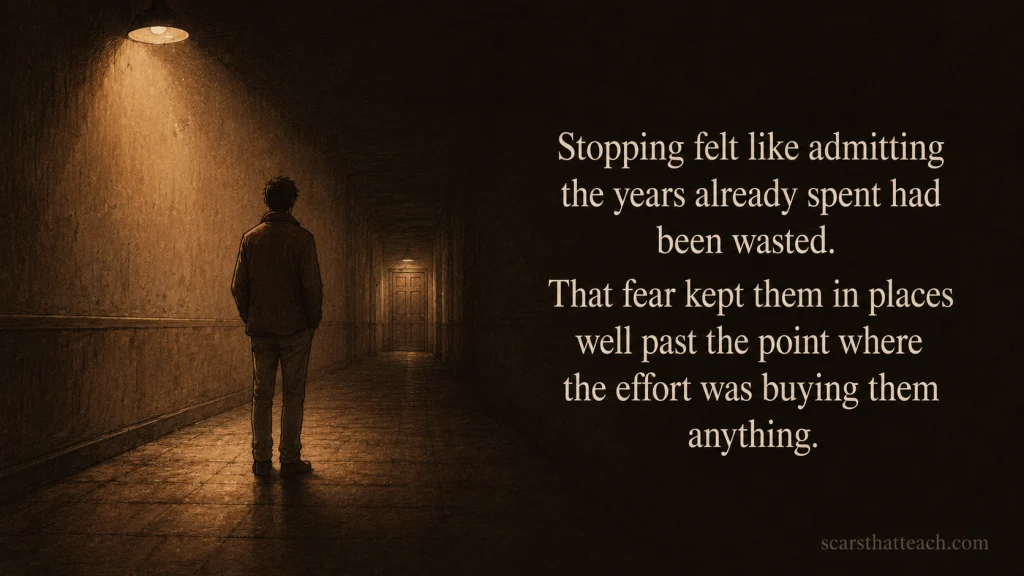
I want to be honest about something most content on hard work avoids saying directly: sometimes stopping is the right call, and it is not a failure of character to make it. I sat with people who kept going long after every honest signal told them the situation had changed, because stopping felt like admitting the years already spent had been wasted. That fear kept them in places, jobs, relationships, projects, well past the point where the effort was buying them anything.
There is no formula that tells you exactly when you have crossed that line, and I distrust anyone who claims there is one. What I can offer is the question that mattered most in the rooms I sat in: if nothing changes about the external circumstances, can you live with continuing to give this the same effort for another year. If the honest answer is yes, because you still believe in what you are doing and the cost is one you can sustain, that is a different situation than continuing because stopping feels unbearable. The first is a choice. The second is often something closer to fear wearing the costume of dedication.

Final Thoughts: Keep Going Honestly, Not Blindly
If you are in the middle of this right now, working hard at something that has given you little or nothing back, I am not going to tell you it will pay off. I do not know that, and neither does anyone else writing about this with any honesty. What I can tell you is that the people I watched come through long stretches like this intact were rarely the ones who simply gritted their teeth and waited. They were the ones who kept adjusting in small, honest ways while the larger effort stayed in place, and who were willing to ask themselves, without flinching, whether they were continuing out of belief or out of fear.
That question will not give you certainty. It will give you something more useful than certainty, which is clarity about why you are still standing where you are standing.
For more on whether hard work reliably leads anywhere, my piece on whether hard work actually pays off goes deeper into that larger question. And if you want a wider view on persistence and what it actually requires, the broader collection on motivation and what keeps people going through hard seasons covers ground this piece only touches on.
FAQs
💪 How do I keep working hard when nothing is happening?
Start by separating what you control, the quality and consistency of your effort, from what you don’t, timing and outcomes. Then make small adjustments along the way instead of repeating the same approach unchanged.
⏳ How do I know if my results are just delayed or never coming?
There is no certain way to know in advance. Ask whether the controllable part of your effort has had enough time to interact with the uncontrollable part, and whether anything about your situation has genuinely changed.
🛑 When should I stop trying instead of pushing through?
Ask if you could sustain this same effort for another year if nothing external changes. If you still believe in it and can bear the cost, that is different from continuing only because stopping feels unbearable.
😞 Why does working hard without results feel so draining?
Motivation usually relies on a feedback loop between effort and visible results. When that loop is missing, your mind loses its usual signal that the effort is worth continuing, which is exhausting even when nothing else has changed.
🎯 Does hard work always eventually pay off?
No, and anyone who promises that isn’t being honest with you. Consistent effort improves your odds, but timing, randomness, and circumstances outside your control still play a real role in outcomes.